


20 / 05 / 2026
Constança Entrudo studied Textile Design, specialising in printmaking, at Central Saint Martins in London; she has collaborated with Balmain and Peter Pilotto; and in 2018, she launched her namesake brand.
With a free-flowing and unfettered approach, her work reflects a culture in transition. Using fabrics, she explores the boundaries of experimentation, redefining the concept of craftsmanship as a form of intelligence that engages new generations and challenging languages.
Alexandra Novo: Who are today’s artisans? What is your vision for the future, and what aspects are fundamental to your daily practice? Constança Entrudo: Today’s artisans are often designers – or perhaps the distinction between the two is no longer so relevant. It’s mostly a case of semantics. What really matters is the relationship with the act of making. I'm interested in thinking of the contemporary artisan as someone who is much more than a technician. They might be someone who designs, questions, tests and redefines processes. It’s very important to encourage critical thinking at every stage of development. For me, the design process doesn’t end when the piece has been ‘designed’ – it’s an ongoing process of construction and communication from start to finish.
In your studio, you manually develop fabrics and prints that span boundaries and disciplines, not being confined to applications in fashion, but also in art and interiors. What projects have you been developing in these parallel areas? We have been working on several interior design projects – which is something I’d wanted to do for a long time. The first one was Bela, the speakeasy inside the Barbela restaurant in Lisbon. It began with a commission for a curtain featuring printed lines, which was to cover and envelop the entire space, and ended up becoming a complete project, for which we carried out a colour study, designed the floor (a ‘handmade’ terrazzo created in collaboration with the artist Maria Ana Vasco Costa), the furniture and lighting, and, of course, the curtain itself, which is the centrepiece. This project means a great deal to me; it reflects my work in such a clear way. We have also been collaborating with the architect Duarte Caldas’s studio, DC.AD; we developed the textile design for the Sophia restaurant, part of his studio, and we have three further projects planned for this year.
You recently took part in a debate at the United Nations on the use of Artificial Intelligence (AI) in the textile sector. Is AI an ally or a threat? AI has become essential to me, but recently I’ve felt the urge to make an effort to design or write without this constant crutch. The other day I read an article by Tim Harford on the idea of self-maintenance, which spoke of the importance of knowing how to maintain, rather than improve. I’ve been thinking a lot about this in the context of our relationship with AI. We are no longer dealing with machines that we can take apart, understand and adjust. I think this distance, this mystery, is dangerous. It leaves behind us something important, which is understanding the process. Whether through technology or manual labour, for me it is essential not to lose that connection, what we call savoir-faire. However, there is also another issue that concerns me: the misuse of words in the service of creating narratives. I am particularly concerned about the use of terms such as “craft” (one of ChatGPT’s favourite words, for example). These days, everything is “craft”: we see fast fashion campaigns talking about “crafting stories”, or mass-produced goods being presented as “crafted” or “hand finished”, when, in fact, they are not. I believe that many people don't even realise that, in a sense, they have lost control over the content they are producing. And it is important that this is questioned; otherwise, words such as “transparency” – which also seem to be used a great deal by AI – will end up losing their meaning entirely.
Alexandra Novo: Who are today’s artisans? What is your vision for the future, and what aspects are fundamental to your daily practice? Constança Entrudo: Today’s artisans are often designers – or perhaps the distinction between the two is no longer so relevant. It’s mostly a case of semantics. What really matters is the relationship with the act of making. I'm interested in thinking of the contemporary artisan as someone who is much more than a technician. They might be someone who designs, questions, tests and redefines processes. It’s very important to encourage critical thinking at every stage of development. For me, the design process doesn’t end when the piece has been ‘designed’ – it’s an ongoing process of construction and communication from start to finish.
In your studio, you manually develop fabrics and prints that span boundaries and disciplines, not being confined to applications in fashion, but also in art and interiors. What projects have you been developing in these parallel areas? We have been working on several interior design projects – which is something I’d wanted to do for a long time. The first one was Bela, the speakeasy inside the Barbela restaurant in Lisbon. It began with a commission for a curtain featuring printed lines, which was to cover and envelop the entire space, and ended up becoming a complete project, for which we carried out a colour study, designed the floor (a ‘handmade’ terrazzo created in collaboration with the artist Maria Ana Vasco Costa), the furniture and lighting, and, of course, the curtain itself, which is the centrepiece. This project means a great deal to me; it reflects my work in such a clear way. We have also been collaborating with the architect Duarte Caldas’s studio, DC.AD; we developed the textile design for the Sophia restaurant, part of his studio, and we have three further projects planned for this year.
You recently took part in a debate at the United Nations on the use of Artificial Intelligence (AI) in the textile sector. Is AI an ally or a threat? AI has become essential to me, but recently I’ve felt the urge to make an effort to design or write without this constant crutch. The other day I read an article by Tim Harford on the idea of self-maintenance, which spoke of the importance of knowing how to maintain, rather than improve. I’ve been thinking a lot about this in the context of our relationship with AI. We are no longer dealing with machines that we can take apart, understand and adjust. I think this distance, this mystery, is dangerous. It leaves behind us something important, which is understanding the process. Whether through technology or manual labour, for me it is essential not to lose that connection, what we call savoir-faire. However, there is also another issue that concerns me: the misuse of words in the service of creating narratives. I am particularly concerned about the use of terms such as “craft” (one of ChatGPT’s favourite words, for example). These days, everything is “craft”: we see fast fashion campaigns talking about “crafting stories”, or mass-produced goods being presented as “crafted” or “hand finished”, when, in fact, they are not. I believe that many people don't even realise that, in a sense, they have lost control over the content they are producing. And it is important that this is questioned; otherwise, words such as “transparency” – which also seem to be used a great deal by AI – will end up losing their meaning entirely.


One of the most visible aspects of your artistic language lies in the technique you created, unwoven (“destecelagem”). What does it consist of, and what symbolism is associated with this method? This unwoven technique, which I used to call threads, is something I have been exploring since the very beginning. It is almost a rejection of the loom and the traditions associated with it. Traditional weaving crosses two systems of threads – the warp and the weft – but at a certain point this structure started to seem limiting to me. That’s how I began to develop this technique where there is only the warp, creating a fabric with an almost taut appearance, where the threads seem loose. The process is based on connecting threads (essentially the warp), all placed by hand, thread by thread, directly onto the mould, which also helps to minimise waste. Each piece can take over a week to make. Although the result may look imperfect, it's actually the result of a long process of research and technical development.


Related Articles
-

Creating the Unexpected
Holland Park house, designed by the Maddux Creative studio, challenges the rigidity of conventional forms in contemporary architecture. -
Land, Sea and Essence
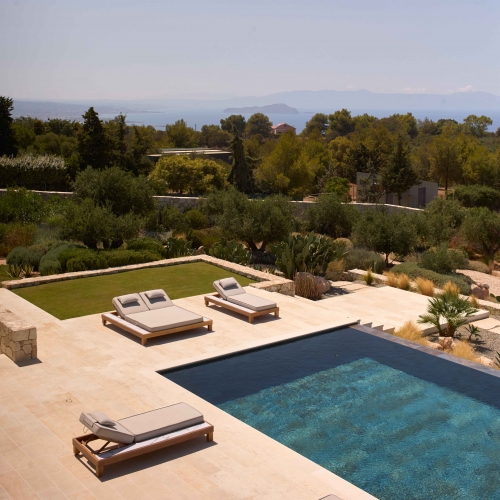
On the slopes of Chania, on the Greek island of Crete, Cari Giannoulias has designed her own summer retreat — a house crafted from stone, memories and the sea, where understated refinement blends with the soul of Greek villages. -
Ageless Harmony
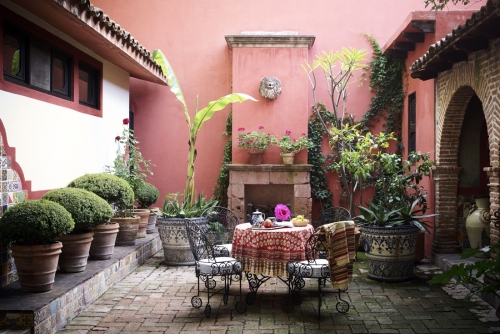
A property to pass on, from generation to generation, that proudly praises ancestral components, in a bold mixture of patterns and influences from all over the world.
